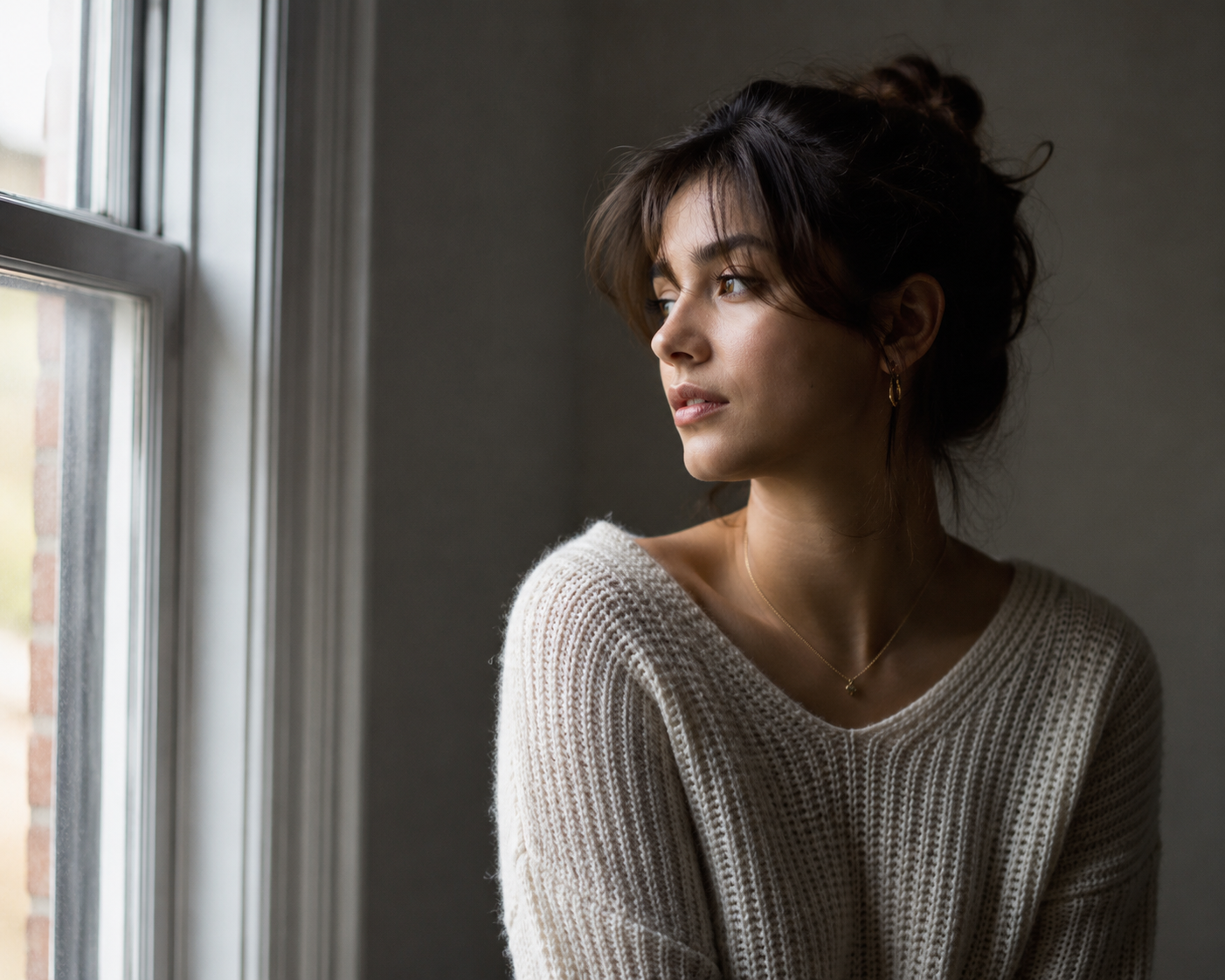
Why Window Light Works
A window functions as a large, soft light source. Even on a bright day, a window diffuses direct sunlight into a broad area of illumination. The larger the window relative to the subject, the softer the light. This quality — large source, close to the subject — is exactly what studio softboxes are engineered to replicate.
Window light also has directionality. Unlike flat overhead indoor lighting, it comes from one side, creating the gentle shadow gradients that give portraits dimension. The combination of size, softness, and direction makes window light one of the most practical portrait tools available without any equipment.
Best Windows for Photography
Larger windows provide more light and softer illumination. A full-length floor-to-ceiling window produces significantly different results from a small bathroom window. When choosing a location, consider:
- North-facing windows: Provide consistent, indirect light all day. No direct sun means no harsh patches or changing conditions as you shoot.
- East-facing windows: Direct morning light, diffused indirect light in the afternoon. Good for early sessions.
- West-facing windows: Indirect light in the morning, warm direct light in the afternoon. Useful if you want a warmer quality.
- South-facing windows: Receive direct sun for much of the day. Often too harsh without diffusion, but can work if managed with sheer fabric or a diffusion panel.
Positioning Your Subject
The angle between the subject and the window determines the light pattern on their face. The three primary positions:
- 45-degree angle to window: Classic portrait lighting. The light falls across the face, lighting one side brightly and casting a soft shadow on the other. This creates dimension without extreme contrast.
- Facing the window directly: Produces front light — even illumination, minimal shadows, clean and straightforward. Works well for commercial and product-style portraits.
- Perpendicular to window (90 degrees): Creates split lighting — one half of the face is lit, the other is in shadow. More dramatic and less conventional for standard portraits, but striking for certain editorial styles.
The subject's distance from the window also matters. Closer to the glass means brighter, more contrasty light that falls off quickly behind them. Stepping back from the window reduces contrast and spreads the light more evenly.
Light Feathering
Feathering means using the edge of the light source rather than its center. When a subject is positioned at the far edge of the window's beam rather than in the middle of it, the light is softer and more gradual. Moving the subject slightly further from the window's center, or rotating the window relative to the subject, uses this principle.
Feathering is particularly useful when a window produces slightly harsh light. Instead of adding diffusion, try adjusting the angle between subject and window before reaching for any modifier.
Using Reflectors
A reflector placed on the shadow side of the subject bounces window light back into the darker areas of their face, reducing contrast. A white foam board from a dollar store or craft store is a fully adequate reflector for this purpose.
Silver reflectors bounce more light and produce a slightly cooler quality. White reflectors produce less bounce and a neutral color. Gold reflectors add warmth — use cautiously as they affect skin tones. Position the reflector until the shadow side lifts to the density you want, then lock it in place or have an assistant hold it.
Controlling Contrast
Window light contrast is determined by the relationship between the window size, the subject's distance from it, and the reflectivity of the room. A white-painted room will naturally fill shadows because the walls bounce light. A dark room will produce deeper, more dramatic shadows.
Ways to reduce contrast:
- Move the subject further from the window
- Add a reflector on the shadow side
- Place a sheer curtain over the window to diffuse direct light
- Use a white wall or white foam board as a fill bounce
To increase contrast, do the reverse — move the subject closer, remove reflectors, and work in a darker-walled space.
Camera Settings for Window Light
Window light indoors is usually several stops dimmer than outdoor light. Your camera needs to compensate. General starting points:
- Aperture: f/1.8–f/2.8 for shallow depth of field and maximum light. If you need more depth, open your shutter or raise ISO instead.
- Shutter speed: 1/100s–1/250s for static subjects. Go no slower than 1/60s if the subject might move.
- ISO: Start at 400 and raise as needed. Modern cameras handle ISO 1600–3200 cleanly for portrait work.
- White balance: Daylight (5500K) or Cloudy (6500K) depending on the window's orientation and time of day. Auto white balance works well if you shoot RAW and intend to adjust in post.
Frequently Asked Questions
Which direction should a window face for the best portrait light?
North-facing windows (in the northern hemisphere) receive no direct sunlight and provide consistent, soft, diffused light throughout the day. South-facing windows get direct sun for much of the day, which can be too harsh unless you diffuse it. East- and west-facing windows provide excellent light in the mornings and afternoons respectively.
What if my window lets in direct sunlight that is too harsh?
Hang a white sheer curtain, tape white tracing paper, or use a diffusion panel against the window. This spreads the direct beam across a larger surface, softening it significantly without blocking the light entirely.
How far should a subject be from the window?
Closer to the window produces more contrast — brighter highlights, deeper shadows, and a more dramatic look. Moving the subject farther back reduces contrast and produces more even illumination. Start at roughly 3–5 feet and adjust based on the look you want.
Do I need a reflector for window light portraits?
Not always. If you want lower contrast and filled shadows, a white foam board opposite the window is cheap and effective. If you prefer the shadow detail and more dramatic light, skip it. The choice is stylistic, not technical.
What camera settings work best for window light?
Start with aperture f/1.8–f/2.8 for a blurred background, ISO 400–1600 depending on available light, and shutter speed fast enough to avoid motion blur (1/100s or faster for people). Use auto white balance or set it manually to the daylight preset for accurate color.