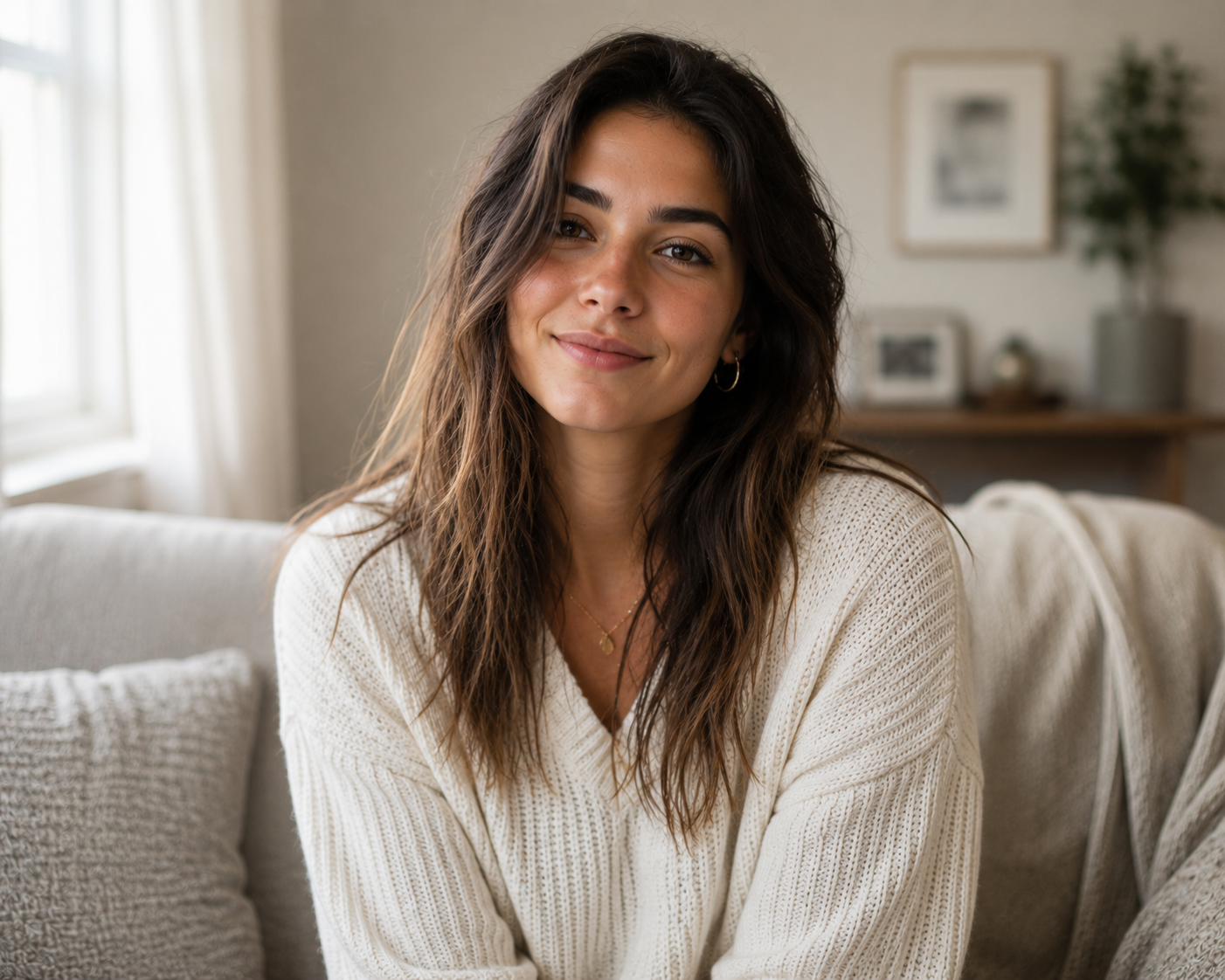
The Indoor Portrait Challenge
Indoor environments present a consistent set of challenges for portrait photography: limited light, mixed color temperatures, and backgrounds that are often closer and more cluttered than outdoor settings. The fundamental problem is that typical indoor lighting levels are 100 to 1000 times dimmer than outdoor daylight. The camera settings that work beautifully outside often fall apart completely indoors.
The solution isn't a single set of numbers — it's a framework for managing the tradeoffs between aperture, shutter speed, and ISO. You need enough shutter speed to freeze subject movement, enough aperture to let in adequate light, and enough ISO to bridge the gap. Understanding which setting to sacrifice first in a given situation is the practical skill that separates consistent indoor portraits from frustrating failures.
Equipment matters here more than it does outdoors. A lens with a maximum aperture of f/1.4 to f/2 makes indoor portrait photography significantly more achievable than a kit zoom at f/5.6. If you shoot portraits regularly indoors and own only kit lenses, a 50mm or 85mm f/1.8 prime is one of the most impactful gear upgrades you can make for the money.
Aperture for Indoor Portraits
For indoor portrait work, start with your lens's widest aperture and work narrower only if you need more depth of field. f/2 to f/2.8 is the practical sweet spot — wide enough to gather light aggressively, narrow enough that depth of field is manageable and the lens performs with acceptable sharpness. If your lens doesn't open past f/4, indoor portrait photography in ambient light becomes challenging.
At f/1.4 or f/1.8 indoors, depth of field is extremely shallow — often only a few centimeters. With a subject leaning slightly forward or turning their head, one eye can be sharp while the other is noticeably soft. This isn't necessarily a problem — a single sharp eye with a slightly soft background eye can be intentional and pleasing. But it requires you to nail focus precisely every frame. Eye-detection autofocus, available on most modern mirrorless cameras, makes this dramatically more reliable.
Background separation — one of the appealing qualities of wide-aperture indoor portraits — depends on the distance between subject and background as well as aperture. Indoors, you often can't get much distance between a person and the wall behind them. Moving the subject further from the background (even by a meter) makes a noticeable difference in how blurred the background appears at any given aperture.
Shutter Speed Indoors
Indoors, the temptation is to let shutter speed drop as far as possible to keep ISO manageable. Resist this beyond a point. For portraits of adults standing or seated, 1/160s is a reasonable minimum. People shift, turn their heads, and breathe — even posed subjects introduce motion at very slow shutter speeds. 1/200s is safer and provides a useful buffer.
For children indoors, shutter speed becomes even more important. Kids rarely stay still, and candid indoor moments require at least 1/250s to 1/400s to catch sharp expressions. If the light level drops to the point where these speeds require ISO 3200 or higher, accept the noise. A sharp image at ISO 6400 is better than a blurry one at ISO 800.
If you're photographing in a room with tungsten lighting, be aware that some LED and fluorescent lights flicker at 50Hz or 60Hz depending on the country. At shutter speeds that don't sync with the flicker frequency, you may get banding in the image or inconsistent exposure between frames. Shooting at 1/100s or 1/125s (in 50Hz countries) or 1/120s (in 60Hz countries) helps synchronize with the flicker. Most modern cameras also have an anti-flicker shooting mode that delays the shot to fire during the peak of the flicker cycle.
ISO Indoors
Indoor portrait photography requires accepting higher ISO values than outdoor work. ISO 800 to 3200 is entirely normal in a typical home or venue. The key is knowing how far you can push your specific camera before the noise becomes objectionable for your intended output — social media, print, client delivery, etc.
Test your camera at ISO 800, 1600, 3200, and 6400 in advance. Open the files at 100% zoom and look at skin tones, hair detail, and shadow areas. Find the ISO where noise starts affecting the quality in ways you can't easily correct in post. That becomes your practical ceiling — the point above which you'll need to change something else (add light, open aperture) rather than push ISO further.
Auto ISO with a minimum shutter speed is a practical approach for indoor portraits. Set a minimum shutter speed of 1/200s, a maximum ISO of whatever your ceiling is (e.g., 3200), and an aperture of f/2 or f/2.8. The camera will automatically manage ISO to maintain your minimum shutter speed. When light drops below the level where ISO can compensate, the camera may underexpose — watch the exposure indicator and step closer to a light source if needed.
Using Window Light
A window is often the best indoor portrait lighting available without any additional gear. North-facing windows provide consistent, cool-toned diffuse light throughout the day. South-facing windows bring warmer, more directional light that changes significantly through the day. East and west windows provide directional morning or evening light that can be beautiful but shifts rapidly.
Position the subject two to four feet from the window, facing it or at a 45-degree angle. Facing the window produces even, flat lighting on the face. A 45-degree angle creates Rembrandt-style lighting with a shadow triangle on one cheek. Either approach works — choose based on the mood you're after. The further from the window, the softer and more even the light; the closer, the more directional and dramatic.
In window light, the camera settings depend on how much light is coming through. On a bright overcast day, a subject positioned near a large window may require only ISO 400 at f/2 and 1/200s. On a dark winter afternoon, the same setup might need ISO 1600 or higher. Always check the exposure and adjust ISO first, shutter speed second (staying above your minimum), and only widen aperture further if you've exhausted the other options.
White Balance for Indoor Lighting
Indoor light sources have dramatically different color temperatures from daylight, and mixed light sources — a window combined with overhead tungsten — are among the most challenging situations in photography. Getting white balance right in-camera (or at least close) saves significant editing time and produces more consistent results.
Tungsten/incandescent bulbs: 2700–3200K. Use the Tungsten or Incandescent white balance preset, or set a manual Kelvin value in that range. Warm LED lights fall in this range too. The image will look noticeably cooler/more blue than what your eye sees, but skin tones will render as neutral rather than heavily orange.
In mixed light — particularly a window-lit subject with tungsten overhead fill — you have to choose a compromise. Expose for the dominant light source (usually the window) and set white balance accordingly. In raw, you can make region-specific corrections with local adjustments in editing. For JPEGs, this is difficult to fix in post, so try to eliminate or minimize the conflicting light source when possible — turning off overhead lights and relying on window light alone is often the cleanest solution.
When to Use Flash
When ambient light is insufficient or has unflattering qualities, flash gives you reliable, controllable results. On-camera flash pointed directly at the subject is the least desirable option — it creates flat, harsh light and produces red-eye. If you must use on-camera flash, use a diffuser or bounce the flash off a white ceiling for softer results.
A single off-camera speedlight in a softbox or umbrella is the standard approach for home portrait setups. Position the light at a 45-degree angle to the subject, slightly above eye level — this provides directional light that flatters most faces. A white reflector or foam board on the opposite side fills in the shadow side without additional equipment.
For ambient-flash mixed exposure (sometimes called "dragging the shutter"), use a slower shutter speed to let ambient light register in the background while the flash properly exposes the subject. This produces more natural-looking indoor images than pure flash photography, where backgrounds often go dark. A shutter speed of 1/60s with flash synced to the first curtain is a common starting point for this technique.
Common Indoor Portrait Mistakes
Using too slow a shutter speed to compensate for low ISO: blurry subjects are the result. Raise ISO before dropping shutter speed below 1/160s for any portrait work involving people who aren't completely motionless.
Not accounting for color temperature changes when mixing light sources: a subject lit by cool window light and warm tungsten overhead will have uneven, unflattering color across their face. Turn off overhead lights or position the subject to avoid the mixed-light zone.
Shooting at maximum aperture without precise focus: f/1.4 and f/1.8 require accurate focus on the eyes. If your camera doesn't have reliable eye-detection AF, use single-point AF with the focus point placed on the nearest eye. Confirm sharpness at 100% before moving to a different position.
Forgetting the background: indoors, walls, furniture, and distracting objects are often much closer to the subject than in outdoor shooting. Even a shallow depth of field at f/2 may not fully blur a wall one meter behind the subject. Reposition to increase subject-to-background distance, or choose backgrounds deliberately — a clean wall, a bookshelf, a doorway — rather than shooting against whatever's there.
Frequently Asked Questions
What is the best ISO for indoor portrait photography?
ISO 800 to 3200 covers most indoor portrait situations. In a well-lit room near large windows, ISO 800 may be enough. In a darker interior without supplemental light, ISO 1600 to 3200 is realistic. Don't be afraid to go higher — modern cameras handle high ISO cleanly, and noise reduction in post can recover significant detail.
How do I avoid blurry indoor portraits?
Use a shutter speed of at least 1/160s to 1/200s for stationary subjects. For anyone moving — children, candid moments — go to 1/320s or faster. To achieve these shutter speeds in dim conditions, open aperture as wide as acceptable and raise ISO before letting shutter speed drop.
Should I use flash for indoor portraits?
If available, off-camera flash or a bounced speedlight dramatically improves indoor portrait lighting. Direct on-camera flash is harsh and creates red-eye. Bouncing flash off a white ceiling diffuses it significantly. Without flash, rely on window light — position the subject facing a window for soft, directional light that's hard to replicate artificially.
Why do my indoor photos look orange?
Indoor tungsten or warm LED lighting has a much lower color temperature (2700–3000K) than daylight (5500–6500K). If your white balance is set to Daylight or Auto in a warm-lit interior, the image will have a strong orange cast. Switch to Tungsten (Incandescent) white balance or set a manual Kelvin value around 2700–3200K to neutralize it.
What aperture should I use for indoor family portraits?
For groups of three or more people, use f/4 to f/5.6 to ensure everyone is sharp even with some depth variation. For single subjects, f/2 to f/2.8 provides subject separation and lets in more light. At f/2 on an 85mm lens indoors, the depth of field is narrow enough that focus accuracy really matters — use eye-detection AF if your camera supports it.