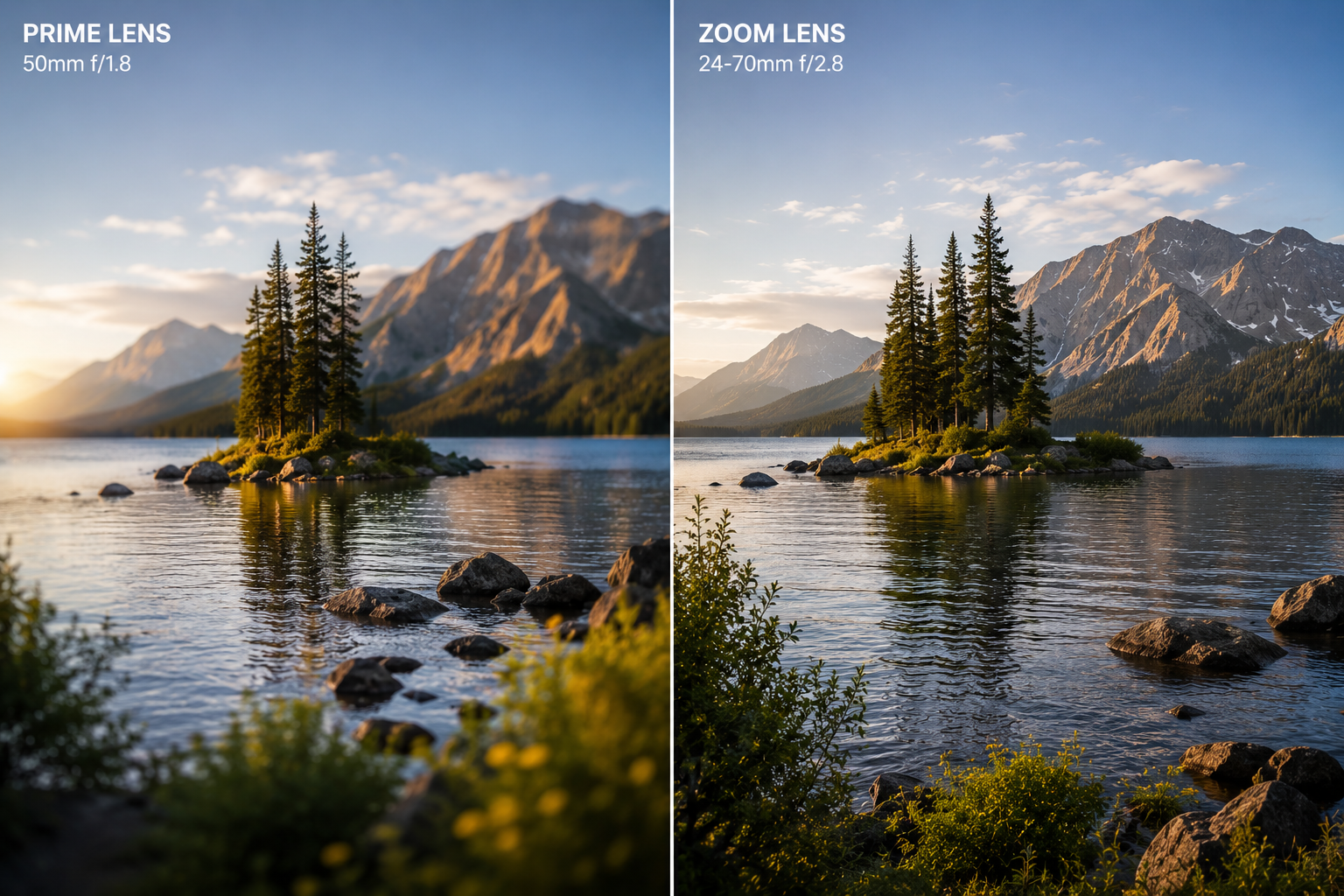
What Is a Prime Lens
A prime lens is fixed at one focal length. A 35mm prime is only a 35mm. A 50mm prime is only a 50mm. To change your framing, you move your feet — or change lenses.
This constraint is both the limitation and the appeal. Because prime lenses don't need to compromise across a focal range, manufacturers can optimize their optical formula entirely for a single focal length. That typically results in sharper rendering, better contrast, fewer aberrations, and — most significantly — larger maximum apertures at lower costs than equivalent zooms.
What Is a Zoom Lens
A zoom lens covers a range of focal lengths within a single lens. An 18–55mm zoom can shoot at 18mm, 35mm, 50mm, and every millimeter in between by rotating the zoom ring. A 70–200mm covers everything from moderate telephoto to strong telephoto.
The optical design of a zoom lens is more complex because it has to produce acceptable results across the entire focal range. Modern zoom lenses — particularly professional-grade options — do this extremely well. But the additional complexity typically comes with trade-offs in aperture, size, weight, and cost.
Image Quality Comparison
At comparable prices, a prime lens generally outperforms a zoom lens in optical quality — sharper at wide apertures, better contrast, less chromatic aberration, and cleaner bokeh. This is especially true in the affordable price range, where the trade-offs of zoom design are most visible.
At the high end, the gap narrows considerably. Professional constant-aperture zoom lenses can produce results that are difficult to distinguish from prime lenses in most real-world shooting conditions. The optical engineering in premium zooms is sophisticated enough to largely eliminate the quality penalty.
For most photographers working with mid-range gear, a prime will deliver noticeably better optical quality at wide apertures than a same-priced zoom. The difference matters most in low light and when printing large.
Maximum Aperture
This is the most practically significant difference between primes and zooms. Fast primes — f/1.4, f/1.8, f/2 — are widely available and relatively affordable. Fast zooms with consistent apertures across their range are significantly more expensive and physically larger.
A wider maximum aperture means more light reaches the sensor, enabling faster shutter speeds in low light, shallower depth of field for stronger background separation, and better autofocus performance in dim conditions. An f/1.8 prime gathers roughly 8x more light than an f/5.6 kit zoom at full zoom — that's the difference between a properly exposed shot and a blurry underexposed one.
If you shoot in low light regularly — indoor events, restaurants, evening outdoor sessions — the aperture advantage of a prime lens is significant and difficult to replicate cheaply with a zoom.
Size and Weight
Prime lenses are typically smaller and lighter than zoom lenses covering equivalent focal lengths. A 50mm f/1.8 prime is usually a compact, lightweight lens. A zoom that covers 50mm as part of its range is physically larger and heavier — more so if it maintains a constant wide aperture throughout.
The exception is ultra-compact zoom lenses designed for mirrorless systems, some of which are impressively small. But as a general rule, if you're trying to travel light, a prime or two will be easier to carry than a zoom with equivalent coverage.
Cost
Budget-friendly prime lenses — particularly 50mm f/1.8 options — are among the most cost-effective lenses available in any camera system. You can often get excellent optical performance for relatively little money because the simple design lends itself to lower manufacturing costs.
Zoom lenses at the budget end tend to compromise more on aperture and optical quality. Professional constant-aperture zooms are expensive — often significantly more than the prime lenses they might replace for specific purposes.
When to Use Prime Lenses
Primes are the better choice when you're shooting in a known environment where your focal length requirements are predictable, when you need maximum aperture performance for low light or background blur, or when you're willing to work with constraints to sharpen your compositional thinking.
- Portraits and headshots
- Indoor photography (weddings, events, restaurants) where light is limited
- Street photography where a compact, discreet lens is useful
- Any shooting where you want the best optical performance at wide apertures
When to Use Zoom Lenses
Zooms are the better choice when you can't control your distance to the subject, when your focal length needs change frequently within a session, or when carrying multiple lenses isn't practical.
- Sports and wildlife where you can't reposition
- Travel, where versatility outweighs optimization
- Events where you need to shift between wide group shots and closer candids quickly
- Journalists and documentary photographers who need to respond fast
There's no rule that says you have to choose one or the other permanently. Most working photographers use both, selecting the tool that fits the situation. Start with whichever type matches your primary use case — and evaluate from real-world experience rather than specification sheets.
Frequently Asked Questions
Are prime lenses always sharper than zoom lenses?
Not always. Modern professional zoom lenses can match or exceed many prime lenses in sharpness. But at equivalent apertures and similar price points, a prime usually has an edge. The gap has narrowed significantly in recent years.
Do professional photographers use zoom lenses?
Constantly. Sports, news, and event photographers especially rely on zooms for their flexibility and ability to respond quickly. Many studio and portrait photographers prefer primes, but it's not a universal rule.
Is a 50mm f/1.8 prime better than an 18-55mm zoom for portraits?
For dedicated portrait work, yes — a 50mm f/1.8 gives you better low-light performance, more background blur, and often better optical quality at wide apertures. But the zoom is more versatile for everyday shooting.
What is the main disadvantage of a prime lens?
You can't zoom — you have to physically move to change your framing. This is limiting in certain situations (wildlife, sports, events) where repositioning isn't possible or fast enough.
Are zoom lenses better for beginners?
They're more convenient, which suits beginners who are still figuring out what they like to shoot. But shooting with a prime teaches you to think about composition and framing more deliberately, which has real educational value.