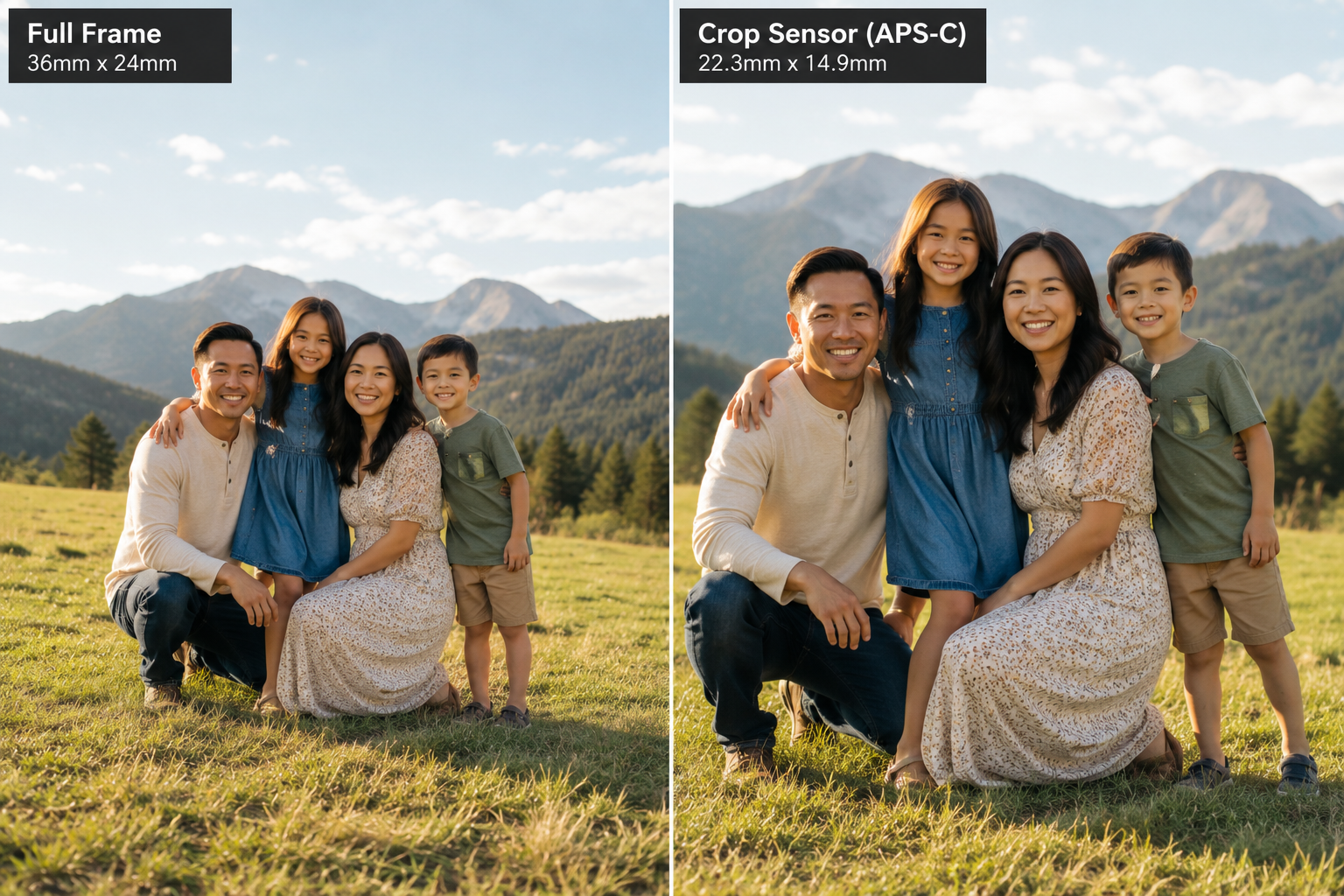
What Sensor Size Actually Changes
The sensor is the digital equivalent of film — it's the surface that captures light and translates it into an image. A larger sensor captures more light across a wider area, which has specific downstream effects: better performance in low light, more control over depth of field, and a different relationship between focal length and field of view.
What sensor size does not directly determine: sharpness, color accuracy, composition, or whether your photographs are good. These depend primarily on technique, light, and lens quality. Sensor format is one factor among many — and often not the most important one in typical shooting conditions.
Full Frame
Full-frame sensors measure 36mm x 24mm — the same dimensions as a 35mm film frame. This is where the term "full frame" comes from. The larger sensor area gathers more light per unit area, which gives full-frame cameras an edge in high-ISO noise performance and enables shallower depth of field at equivalent apertures.
Full-frame systems command a price premium at every level — bodies and lenses both cost more than their APS-C equivalents. They also tend to be physically larger and heavier, since the optical designs for the larger sensor require bigger glass elements.
Full frame is the right choice when low-light performance is critical (events, weddings, indoor available light), when maximum depth of field control matters (portrait work where you want very shallow focus), or when you're investing in a long-term professional system and want to work at the format most professional photographers use.
APS-C (Crop Sensor)
APS-C sensors measure roughly 23.5mm x 15.6mm (though this varies slightly by manufacturer), giving a crop factor of approximately 1.5x to 1.6x. This means a 50mm lens on an APS-C camera behaves like a 75–80mm lens would on a full-frame camera in terms of field of view.
APS-C cameras are less expensive at every price tier, smaller and lighter overall, and offer more effective reach with telephoto lenses — which makes them popular with wildlife and sports photographers. Modern APS-C sensors produce excellent image quality across most shooting conditions, and the performance gap with full frame is narrower than it was a decade ago.
For beginners, APS-C is often the more practical choice. The cost savings are real, the image quality is more than sufficient for most uses, and the reduced size and weight make the system easier to carry and use consistently.
Micro Four Thirds
Micro Four Thirds (MFT) sensors are smaller still — roughly 17.3mm x 13mm — with a 2x crop factor. A 25mm lens on Micro Four Thirds gives a field of view equivalent to a 50mm on full frame. The system is shared between multiple manufacturers, meaning a wide range of lenses and bodies are compatible with each other across brands.
MFT cameras are typically the most compact interchangeable-lens option available — significantly smaller than full-frame or APS-C equivalents, especially combined with the correspondingly smaller lenses. This makes them appealing for travel, street photography, and any context where minimizing pack weight matters.
The trade-offs are in low-light performance (the smaller sensor gathers less light per pixel at equivalent settings) and depth of field control (achieving very shallow depth of field requires shorter focal lengths than other formats). For most shooting, these trade-offs don't show up in the final images.
Sensor Format Comparison
| Feature | Full Frame | APS-C | Micro Four Thirds |
|---|---|---|---|
| Sensor size | 36 x 24mm | ~23.5 x 15.6mm | 17.3 x 13mm |
| Crop factor | 1x (none) | 1.5x – 1.6x | 2x |
| Relative price range | High | Mid | Low–Mid |
| Depth of field (equivalent settings) | Shallowest | Moderate | Deepest |
| Low-light performance | Excellent | Very Good | Good |
| Size and weight | Larger | Mid | Most compact |
| Telephoto reach advantage | None | 1.5x–1.6x | 2x |
| Best suited for | Portraits, events, studio, low light | All-around, sports, wildlife | Travel, street, documentary |
Crop Factor and Focal Length
The crop factor doesn't change the physical focal length of your lens — it changes the effective field of view compared to a full-frame reference. A 50mm lens is still a 50mm lens on any camera, but on an APS-C body it frames a scene the same way a 75mm lens would on full frame.
This matters when choosing lenses. On an APS-C camera, a 35mm prime gives you a normal field of view similar to what 50mm produces on full frame. A 50mm on APS-C behaves more like a short telephoto — great for portraits, less natural for general shooting. Knowing your crop factor helps you choose lenses that actually produce the field of view you're after.
Which Format to Choose
For most beginners: APS-C is the practical choice. It delivers excellent image quality, supports a wide range of lenses at accessible prices, and is available in compact, easy-to-handle camera bodies. The money saved over full frame can go toward glass, which has more impact on your actual photos.
Choose full frame if you know you'll be shooting primarily in low light (weddings, events, indoor sports), if portrait work with maximum background blur is the primary goal, or if you're entering a professional context where full frame is the expected standard in your market.
Choose Micro Four Thirds if portability and weight are primary concerns — for serious travel photographers or anyone who won't use a system they find too heavy to carry, MFT's size advantage is a genuine practical benefit that outweighs the theoretical performance gap.
Frequently Asked Questions
Is full frame always better than crop sensor?
No. Full frame offers advantages in low-light performance and depth of field control, but crop sensors are lighter, less expensive, and offer more reach with telephoto lenses. For wildlife and sports photography, many photographers prefer a crop sensor for this reason.
Can a beginner tell the difference between full frame and APS-C images?
In most normal shooting conditions, no. The differences in high-ISO performance and depth of field are measurable but not obvious in typical prints or on-screen viewing at typical sizes. The sensor format gap has shrunk significantly in recent camera generations.
Do I need full frame for professional photography?
No. Professional photographers work across all sensor formats depending on their specialty. Wedding, portrait, and commercial photographers use full frame often, but wildlife, sports, and travel photographers frequently use APS-C or Micro Four Thirds systems.
Does crop factor affect my kit lens?
Yes. An 18–55mm kit lens on an APS-C camera gives you an effective field of view equivalent to roughly 27–83mm on full frame. This makes the wide end less wide but the telephoto end more useful than the focal length numbers suggest.
Is Micro Four Thirds good enough for serious photography?
Yes. Micro Four Thirds cameras are capable of professional-quality results in most scenarios. The main limitations are in extreme low-light performance and maximum depth of field blur. For travel, documentary, and everyday photography, the size and weight advantages are significant.