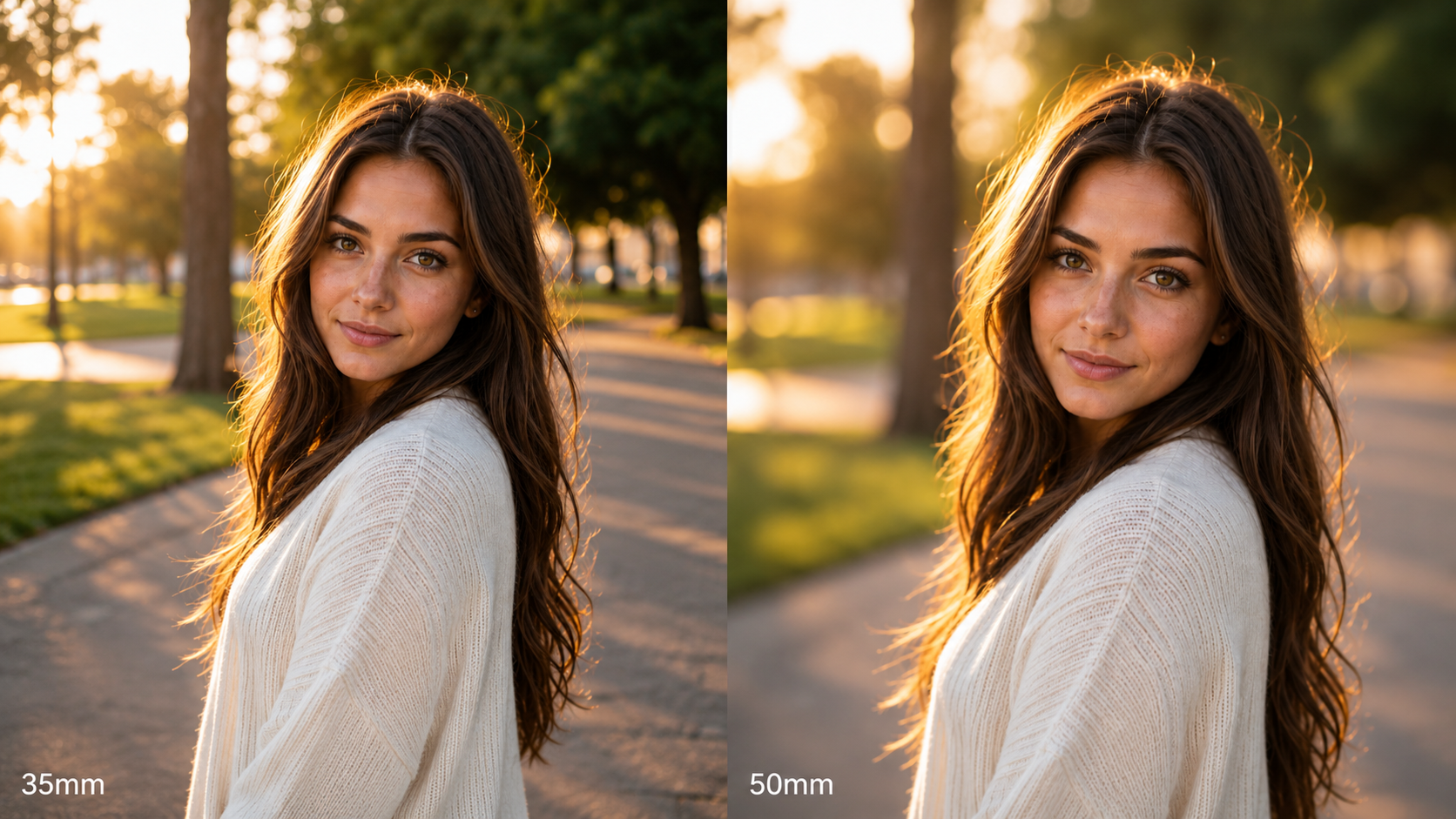
Field of View Comparison
On a full-frame camera, a 35mm lens captures a roughly 63-degree angle of view. A 50mm narrows that to about 47 degrees. In practical terms, the 35mm fits more of the scene into the frame — more background, more environment, and more of the subject's body if you're shooting at a similar distance.
Neither focal length is a "true" portrait lens in the classic sense — that label usually goes to 85mm and longer. But both the 35mm and 50mm are used constantly for portraits precisely because their versatility makes them everyday lenses that double as portrait options.
Perspective and Compression
The more meaningful difference between these two focal lengths isn't framing — it's perspective. When you shoot with a 35mm, you're physically closer to your subject to fill the frame. That proximity amplifies perspective: the nose appears slightly larger relative to the ears, and depth relationships in the scene feel more pronounced.
The 50mm requires you to step back. That extra distance compresses perspective slightly — facial features look more proportional, the background appears a bit closer to the subject, and the overall image has a more "natural" quality that many photographers associate with how we actually see people in front of us.
Neither is objectively better. Perspective distortion from the 35mm is often described as "dynamic" or "intimate." The flatter rendering of the 50mm is described as "natural" or "classic." Your preference likely depends on the feeling you're going for.
35mm for Portraits: Strengths and Limitations
The 35mm excels in portrait situations where context matters. If you want your subject framed within their environment — a musician on a stage, a chef in a kitchen, a person walking through a city street — the 35mm does this naturally without requiring you to back up into a wall or the middle of traffic.
- Pros: Environmental context, intimate feel, versatile for full-body and half-body shots, works well in tighter spaces.
- Cons: Close-up headshots risk perspective distortion, requires careful positioning to avoid unflattering angles, less background separation at equivalent distances.
The 35mm is a favorite among documentary and editorial photographers for exactly this reason. It keeps the subject connected to their surroundings rather than isolated from them.
50mm for Portraits: Strengths and Limitations
The 50mm is often called the "nifty fifty" not just because of price, but because it produces images that match closely with how the human eye perceives a scene. For portraits, this means faces that look proportional, backgrounds that relate naturally to the foreground, and a rendering that feels neither wide nor compressed.
- Pros: Flattering for faces, natural perspective, excellent for headshots and bust portraits, strong background blur at wide apertures.
- Cons: Less environmental context, requires more distance for full-body work, not as versatile for tight indoor spaces.
For straightforward portraiture — headshots, half-body shots, environmental portraits where the subject is the clear priority — the 50mm is rarely the wrong answer.
Comparison at a Glance
| Feature | 35mm | 50mm |
|---|---|---|
| Angle of view (full frame) | ~63° | ~47° |
| Perspective distortion (close up) | More pronounced | Minimal |
| Environmental context | Excellent | Moderate |
| Flattering for tight headshots | Less so | Yes |
| Background separation (same distance) | Less | More |
| Works in small spaces | Better | Adequate |
| Best portrait style | Editorial, lifestyle, documentary | Classic, headshot, fashion |
Working Distance
Working distance is how far you need to stand from your subject to achieve the framing you want. For a head-and-shoulders portrait, the 35mm requires you to be roughly 2–3 feet away. The 50mm gives you more breathing room — typically 4–5 feet for the same framing.
This matters in practice. Subjects who are camera-shy or uncomfortable often relax more when the photographer isn't standing inches from their face. The 50mm's extra working distance can make a real difference in how people behave in front of the camera.
In tight spaces — a bedroom, a small studio, a narrow hallway — the 35mm's shorter working distance becomes an asset rather than a limitation. You can still get close framing without physically leaving the room.
Which to Choose
If most of your portrait work is lifestyle, documentary, or editorial — where context and environment are part of the story — lean toward the 35mm. It will force you to engage more with your subject and their surroundings.
If you primarily shoot headshots, more controlled sessions, or portraits where the subject needs to be clearly isolated, the 50mm is the more reliable choice. It handles close-up work without the distortion risk and gives you slightly better background separation at equivalent apertures.
If you own one and are thinking about adding the other: they complement each other well. But if you're choosing just one, shoot a few test portraits at both focal lengths and let the results tell you which rendering you naturally prefer.
Frequently Asked Questions
Is 35mm too wide for portraits?
Not necessarily. A 35mm can produce flattering portraits if you keep moderate working distance and avoid shooting too close to the subject's face. It works especially well for environmental portraits and three-quarter or full-body shots.
Which focal length is more flattering for faces?
The 50mm is generally considered more flattering for tight headshots because it produces less perspective distortion than the 35mm. The 35mm can exaggerate facial features slightly when used close up.
Can I use a 35mm for studio portraits?
Yes, but you'll need more physical space to back up enough to avoid distortion. In a small studio, a 35mm can feel cramped. The 50mm is more practical for most studio setups.
Do professionals use 35mm for portraits?
Many do — particularly for editorial, documentary, and lifestyle work. Wedding photographers often favor the 35mm for its ability to capture the environment along with the subject.
What's the crop factor impact on these focal lengths?
On an APS-C sensor (1.5x or 1.6x crop), a 35mm behaves like a 52–56mm and a 50mm behaves like a 75–80mm. That pushes both lenses toward more traditional portrait territory on crop bodies.