What Is Aperture
Aperture is the opening inside your lens through which light passes to reach the camera sensor. Think of it like the pupil of an eye — wider in dim conditions to let in more light, narrower in bright conditions to restrict it. Every lens has an iris diaphragm made of overlapping blades that opens and closes to control how large this opening is.
Unlike shutter speed or ISO, aperture lives inside the lens itself, not the camera body. That's why two cameras with identical sensors can produce completely different images depending on the lens attached. Aperture is also the setting most directly responsible for the look and character of your image — specifically through its effect on depth of field.
You'll see aperture expressed as an f-number or f-stop: f/1.4, f/2.8, f/8, f/16. These numbers describe the ratio of the focal length to the aperture diameter. They're counterintuitive at first — the smaller the number, the larger the opening — but that logic becomes second nature with practice.
How F-Stops Work
Each full f-stop either doubles or halves the amount of light entering the lens. The standard full-stop sequence is: f/1, f/1.4, f/2, f/2.8, f/4, f/5.6, f/8, f/11, f/16, f/22. Moving from f/4 to f/2.8 doubles the light. Moving from f/4 to f/5.6 cuts it in half. Most cameras also allow half-stop and third-stop increments for finer exposure control.
The numbers aren't arbitrary — they're derived from the square root of 2 (approximately 1.414). Each step multiplies by that factor because doubling the area of a circle requires multiplying its diameter by √2. This is why the sequence looks unusual compared to simple doubling: 1, 1.4, 2, 2.8, 4, 5.6, 8, 11, 16.
When comparing lenses, the maximum aperture listed on the barrel — the widest opening possible — is a primary quality indicator. A lens marked 50mm f/1.4 can open much wider than one marked 50mm f/1.8, letting in more light and enabling shallower depth of field. That extra capability is why fast lenses command higher prices.
Aperture and Depth of Field
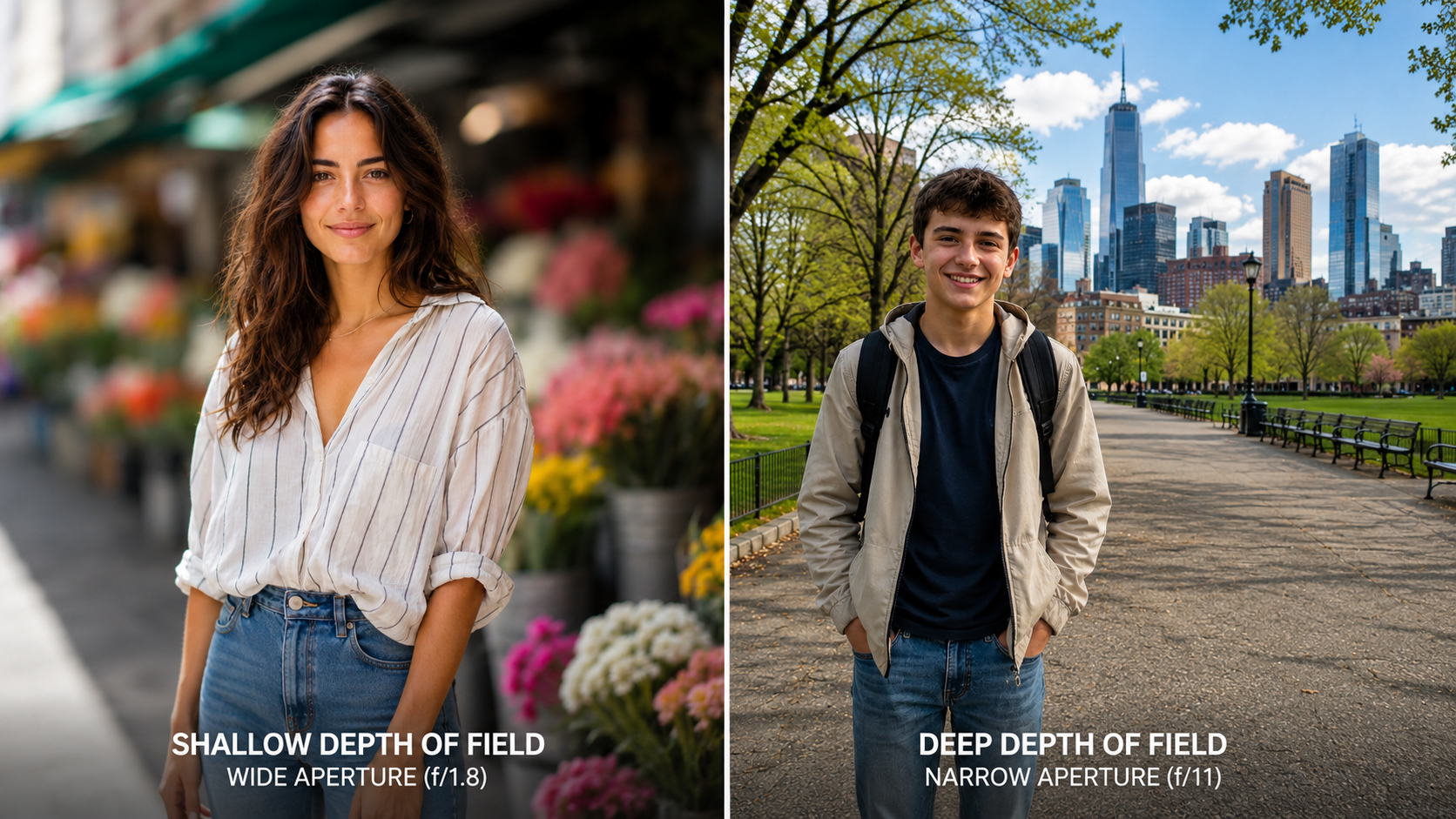
Depth of field (DOF) is the range of distance in a scene that appears acceptably sharp. Aperture is the dominant factor controlling it. A wide aperture like f/1.8 produces shallow depth of field — the subject is sharp, the background is blurred into soft bokeh. A narrow aperture like f/11 produces deep depth of field — everything from near to far appears in focus.
Depth of field is also affected by focal length and subject distance. A 200mm lens at f/5.6 will show much shallower depth of field than a 35mm lens at f/5.6, even though the aperture is the same. Getting closer to your subject also reduces depth of field at any given aperture. When shooting macro photography, even f/16 may only render a few millimeters of the scene in sharp focus.
Shallow depth of field isolates subjects visually — it's why portrait photographers favor f/1.4 to f/2.8. Deep depth of field keeps entire scenes sharp — it's why landscape photographers often work at f/8 to f/11. Understanding this relationship is the key to using aperture creatively rather than reactively.
When to Use Wide Apertures
Wide apertures (low f-numbers like f/1.4 to f/2.8) serve two main purposes: letting in more light and separating subjects from backgrounds. In low light situations — indoor events, evening shoots, candlelit scenes — a wide aperture lets you maintain a reasonable shutter speed and keep ISO manageable. Without a fast lens, the alternative is blurry shots or heavy grain.
For portraits, wide apertures produce the background separation that makes subjects pop. The out-of-focus rendering (bokeh) created by f/1.8 or f/2 on an 85mm lens is difficult to replicate in post-processing. It's a creative choice as much as a technical one — the blurred background removes visual clutter and draws the eye directly to the face.
That said, shooting at maximum aperture demands precise focus. At f/1.4 on a portrait lens, the depth of field may be only a few centimeters. A missed focus point at that aperture means a soft eye and a wasted frame. Use single-point autofocus on the eye closest to camera, and consider shooting a burst to ensure at least one sharp frame.
When to Use Narrow Apertures
Narrow apertures (high f-numbers like f/8 to f/16) maximize depth of field and are the default choice for landscapes, architecture, and any scene where you want front-to-back sharpness. A sweeping mountain scene shot at f/11 will render both the foreground rocks and the distant peaks in sharp detail. The same scene at f/2.8 might have a beautifully blurred background — but you'd lose the context that makes the image work.
Group portraits also benefit from narrower apertures. Shooting a row of five people at f/1.8 is asking for trouble — only the subjects in the same focal plane will be sharp. f/5.6 to f/8 keeps everyone in focus even if the group has some depth. Wider is only appropriate for tight two-person shots where everyone is essentially at the same distance from the lens.
Be cautious about going too narrow. Diffraction — a physical limitation of optics — softens images at very small apertures. Most cameras start showing diffraction around f/16 to f/22. Unless you need the extra depth of field for technical reasons, f/8 to f/11 is the practical ceiling for sharpness.
Aperture and Exposure
Aperture is one leg of the exposure triangle, alongside shutter speed and ISO. Changes to aperture directly affect exposure and must be compensated by adjusting one or both other settings. Opening up from f/8 to f/4 (two stops more light) will overexpose the image unless you either increase shutter speed by two stops or lower ISO by two stops.
In aperture priority mode (A or Av on most cameras), you set the aperture and the camera automatically adjusts shutter speed to achieve correct exposure. This is a practical mode for situations where controlling depth of field matters most — portraits, events, street photography — and you're not shooting subjects that require precise motion control.
In manual mode, you control all three variables. The camera's light meter (usually visible as a scale in the viewfinder or on the display) indicates whether your current combination of aperture, shutter speed, and ISO will produce a correct exposure. Learning to read this meter while in manual mode is the first step to full creative control.
Common Aperture Mistakes
The most common mistake is always shooting wide open. A lens that goes to f/1.4 doesn't mean every shot should be taken at f/1.4. Wide apertures introduce edge softness, chromatic aberration, and razor-thin focus that causes missed shots. Reserve maximum aperture for situations where you genuinely need it — low light, intentional subject isolation — and stop down when the scene allows.
The opposite mistake is stopping down too far in low light to maximize depth of field, then compensating with a slow shutter speed and ending up with motion blur. If you're shooting a moving subject, depth of field is secondary to shutter speed. A sharp image at f/2.8 with slight background blur is always better than a blurry subject with everything in focus at f/11.
Another frequent error is not accounting for how aperture interacts with focal length. f/5.6 on a 24mm wide-angle lens gives substantial depth of field. f/5.6 on a 200mm telephoto gives a very shallow plane of focus. Always think about aperture in the context of the focal length you're using, not as an absolute value.
Frequently Asked Questions
What is a good aperture setting for beginners?
Start with f/5.6 or f/8. These mid-range apertures are forgiving — you get reasonable depth of field, sharp results across most lenses, and enough flexibility for different lighting conditions. Once you understand exposure, experiment wider and narrower.
Does aperture affect sharpness?
Yes, significantly. Most lenses are sharpest two or three stops down from their maximum aperture — typically f/5.6 to f/8. Very wide apertures like f/1.4 often show softness and aberrations. Very narrow apertures like f/16 introduce diffraction, which softens the image. The 'sweet spot' varies by lens.
What is the sweet spot aperture for a lens?
The sweet spot is usually two to three stops narrower than the lens's maximum aperture. For an f/1.8 lens, that's around f/4 to f/5.6. For a kit lens with a maximum of f/3.5, try f/7.1 to f/8. Check lens reviews for your specific glass to find its sharpest aperture.
What is the difference between f/1.8 and f/1.4?
f/1.4 is about two-thirds of a stop wider than f/1.8. In practice, f/1.4 lets in roughly 65% more light and produces shallower depth of field. It also tends to cost significantly more. For most shooting, f/1.8 is the practical choice — the image quality difference is minimal at similar apertures, and the price gap is large.
Why does a smaller f-number mean a larger aperture opening?
F-stop numbers are fractions. F/2 means the aperture diameter is 1/2 of the focal length. F/8 means 1/8 of the focal length. A smaller denominator equals a larger result — so f/2 is a bigger opening than f/8. Think of it as dividing the focal length by the f-number to get the physical size of the opening.