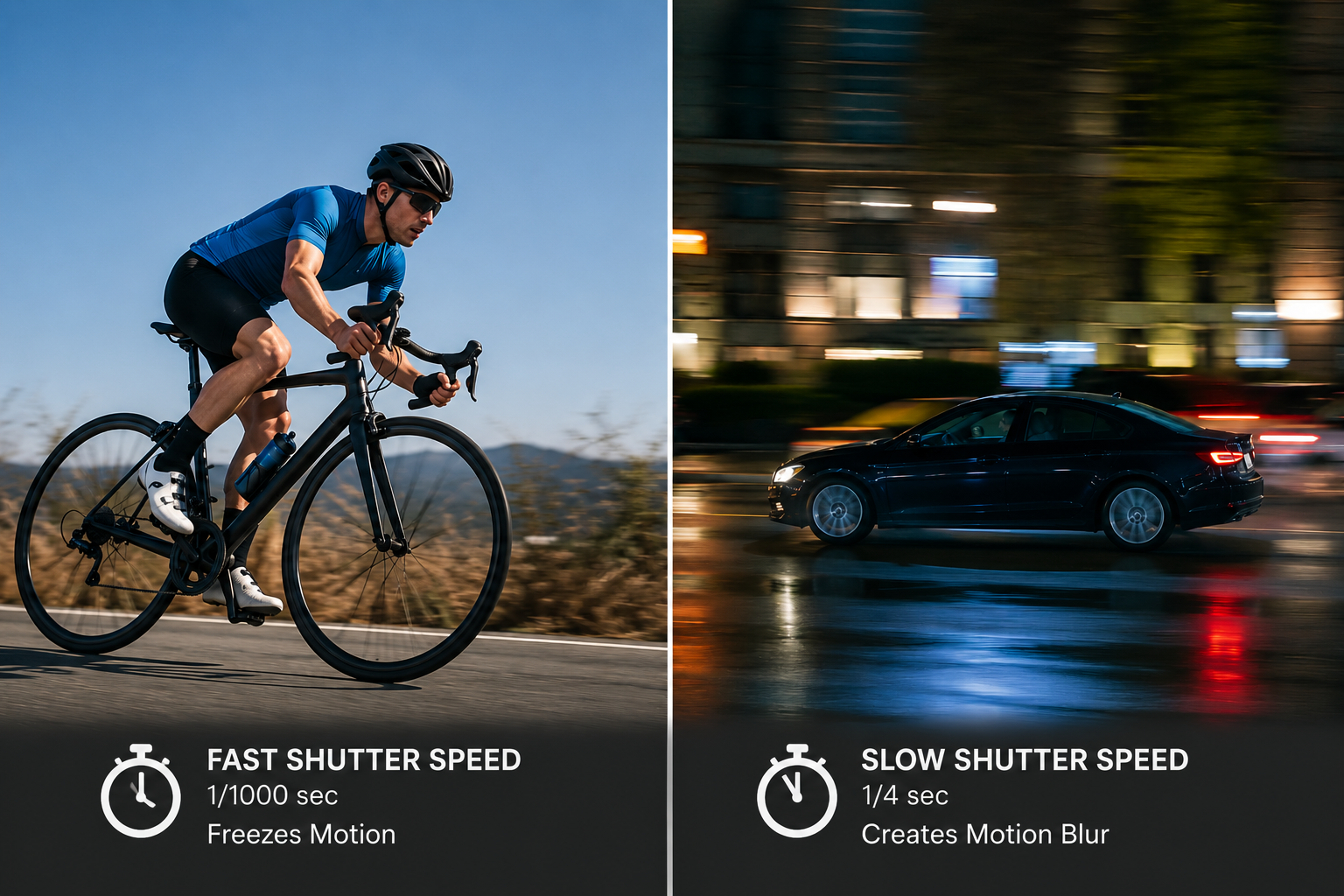
What Is Shutter Speed
Shutter speed is the length of time the camera's shutter remains open during an exposure. When you press the shutter button, a mechanical or electronic curtain opens to expose the sensor to light, then closes again. Shutter speed is the duration of that exposure — measured in seconds or fractions of a second.
In most cameras, a physical shutter mechanism sits just in front of the sensor. It consists of two curtains: the first opens to start the exposure, the second closes to end it. The gap between them determines how long each part of the sensor sees light. In mirrorless cameras, an electronic shutter option is also common, which reads the sensor row by row rather than using a moving curtain.
Shutter speed is the most direct control over motion in photography. A fast shutter speed freezes motion; a slow shutter speed allows it to blur. This is both a technical constraint — you need a fast enough shutter to avoid unwanted blur — and a creative tool, since intentional blur can convey speed, flow, and energy in ways that sharp images cannot.
Reading Shutter Speed Values
Shutter speeds are expressed as fractions of a second or whole seconds. On a camera display, 1/500 means one five-hundredth of a second. 1/60 is one-sixtieth of a second. When values reach one second or longer, they're shown as whole numbers: 2, 5, 30 — meaning 2 seconds, 5 seconds, 30 seconds. Some cameras display fractions with a double quote mark: 2" means 2 seconds.
The standard full-stop sequence from fast to slow: 1/4000, 1/2000, 1/1000, 1/500, 1/250, 1/125, 1/60, 1/30, 1/15, 1/8, 1/4, 1/2, 1s, 2s, 4s, 8s, 15s, 30s. Each step halves or doubles the exposure time. Moving from 1/500 to 1/250 doubles the light reaching the sensor. Most cameras allow third-stop or half-stop increments between these values for finer control.
The fastest mechanical shutter speeds on consumer cameras top out at 1/4000s to 1/8000s. Electronic shutters can go faster — some mirrorless cameras offer 1/32000s — useful for shooting wide-open in bright conditions without a neutral density filter. At the other extreme, timed exposures can run up to 30 seconds, with bulb mode extending this indefinitely.
Shutter Speed and Motion
Two types of motion can appear in a photograph: subject motion (the thing you're photographing is moving) and camera motion (you or the camera is moving during the exposure). Fast shutter speeds eliminate both. Slow shutter speeds allow both. The creative question is always which type of blur — if any — serves the image.
Subject motion blur depends on how fast the subject is moving relative to the frame, how far it is from the camera, and which direction it's moving. A car traveling across the frame needs a much faster shutter to freeze than the same car coming directly toward the camera. A subject 5 meters away needs a faster shutter than the same subject 50 meters away. There's no universal "correct" shutter speed — the right value depends on the specific motion in the specific frame.
Camera motion blur — from handholding — is separate from subject motion and addressed by the reciprocal rule (covered below) and image stabilization. A sharp background with a blurred subject means you've correctly frozen camera shake but not subject motion. A sharp subject with a blurred background means the subject was panned successfully. Both foreground and background blurred suggests the shutter speed was too slow for both camera and subject.
Fast Shutter Speed Uses
Sports and action photography require fast shutter speeds to freeze movement cleanly. A runner in full stride needs at least 1/500s; a bird in flight or a splashing water drop may need 1/2000s or faster. The goal is to eliminate all motion blur from the moving subject so that the image looks sharp and decisive, not streaked or smeared.
Children and pets at play are common scenarios where beginner photographers underestimate the required shutter speed. A toddler running across a frame is fast — 1/400s or higher is usually necessary. Dogs in motion are faster still. If your indoor shots of active subjects look soft, insufficient shutter speed (combined with camera shake from a long lens or tight crop) is almost always the culprit.
Fast shutter speeds are also useful for controlling exposure in very bright light. At the beach on a sunny day, even at ISO 100 and f/8, you may need 1/1000s or faster to avoid overexposure. If you want to shoot at wide aperture in daylight — f/1.4 in full sun — you'll need a shutter speed of 1/4000s or a neutral density filter to reduce the incoming light.
Slow Shutter Speed Uses
Slow shutter speeds — from 1/15s down to multi-second exposures — allow creative use of motion blur and let in significantly more light. Waterfalls and rivers photographed at 1/4s to several seconds take on a silky, ethereal quality that faster speeds simply can't produce. The flowing water becomes a smooth streak, abstracting the texture and emphasizing the movement. This requires a tripod; even a slight camera shake will blur the rocks and banks.
Night photography and astrophotography depend on slow shutter speeds. A properly exposed night sky typically requires 10–30 seconds at f/2.8 and ISO 1600–3200. Light trails from cars require 5–20 seconds depending on traffic and desired density. Urban night scenes often look best with exposures of 2–10 seconds to balance ambient light and sky color without either blowing out street lamps or losing shadow detail.
Panning — intentionally moving the camera to track a subject across the frame — is a technique that combines slow shutter speed with deliberate camera motion. At 1/30s to 1/60s, tracking a cyclist or motorcycle produces a sharp subject against a blurred, streaked background that suggests speed more vividly than a frozen image. It requires practice and produces more failures than keepers, but the results are distinctive.
The Reciprocal Rule
The reciprocal rule is the standard guideline for the minimum handheld shutter speed to avoid camera-shake blur. The rule: your minimum shutter speed should be at least the reciprocal of your focal length. For a 50mm lens, that's 1/50s minimum. For a 200mm lens, it's 1/200s. For a 400mm telephoto, 1/400s.
On a cropped-sensor camera, you need to account for the crop factor. A 200mm lens on a camera with a 1.5x crop factor behaves like a 300mm lens, so the minimum shutter speed becomes 1/300s (round up to 1/320s). Ignoring this is a common source of blurry images for photographers switching between sensor formats.
Image stabilization effectively lets you ignore the reciprocal rule by two to four stops in most implementations. With a 200mm lens and 4-stop stabilization, you may get sharp results at 1/30s handheld. However, stabilization only corrects camera movement — not subject movement. If the subject is moving, stabilization does nothing to prevent motion blur. Use stabilization to buy flexibility with static subjects; use faster shutter speeds to freeze moving ones.
Shutter Speed and Exposure
Shutter speed is one third of the exposure triangle, alongside aperture and ISO. Halving the shutter speed halves the light reaching the sensor — a one-stop reduction. Doubling it doubles the light — a one-stop gain. Changes to shutter speed must be compensated by equivalent changes to aperture or ISO to maintain the same overall exposure.
In shutter priority mode (S or Tv), you set the shutter speed and the camera selects an aperture automatically. This is useful for action photography, when maintaining a minimum shutter speed is the priority, and depth of field is secondary. The risk is that in low light, the camera may choose an aperture wider than your lens allows, resulting in underexposure — watch the aperture indicator and raise ISO manually if needed.
When exposure choices conflict — when you need a fast shutter speed for motion but the light is too dim — ISO is typically the solution. Modern sensors handle high ISOs well enough that raising ISO to 3200 or 6400 to maintain a usable shutter speed is a reasonable tradeoff. A noisy but sharp image almost always has more value than a clean but motion-blurred one. Train yourself to think of ISO as the tool you reach for when shutter speed and aperture can't both be what you need them to be.
Frequently Asked Questions
What shutter speed should I use for portraits?
For stationary subjects, 1/125s to 1/250s is a reliable starting point. It's fast enough to prevent blur from minor subject movement and camera shake, while slow enough to allow reasonable aperture and ISO choices. If shooting with a telephoto lens, use the reciprocal rule and increase shutter speed accordingly.
What does 1/4000s shutter speed do?
1/4000s freezes virtually all motion — running athletes, birds in flight, splashing water. It's also useful for shooting at wide apertures in bright daylight, where without a neutral density filter, the exposure would be overblown. Not all cameras offer 1/4000s; entry-level bodies may top out at 1/2000s.
Can I use a slow shutter speed handheld?
With image stabilization, many photographers can shoot handheld at 1/15s or even 1/8s and get sharp images — but it requires good technique and multiple frames. Without stabilization, the reciprocal rule applies. For moving subjects, slow shutter speeds always introduce blur regardless of stabilization, since IS compensates for camera shake, not subject movement.
What is bulb mode?
Bulb mode keeps the shutter open for as long as you hold the shutter button (or use a remote release). It's used for very long exposures — star trails, light painting, traffic streams — where even the longest timed shutter speed (typically 30 seconds) isn't enough. A sturdy tripod and a remote shutter release are essential for bulb mode work.
How does shutter speed affect video differently than photos?
In video, the 180-degree rule recommends setting shutter speed to roughly double your frame rate — so 1/50s for 25fps, 1/60s for 30fps. This produces natural-looking motion blur. Faster shutter speeds produce a choppy, staccato look; slower speeds create excessive blur. Unlike photography, you don't freely adjust shutter speed for exposure in video without affecting the motion character.