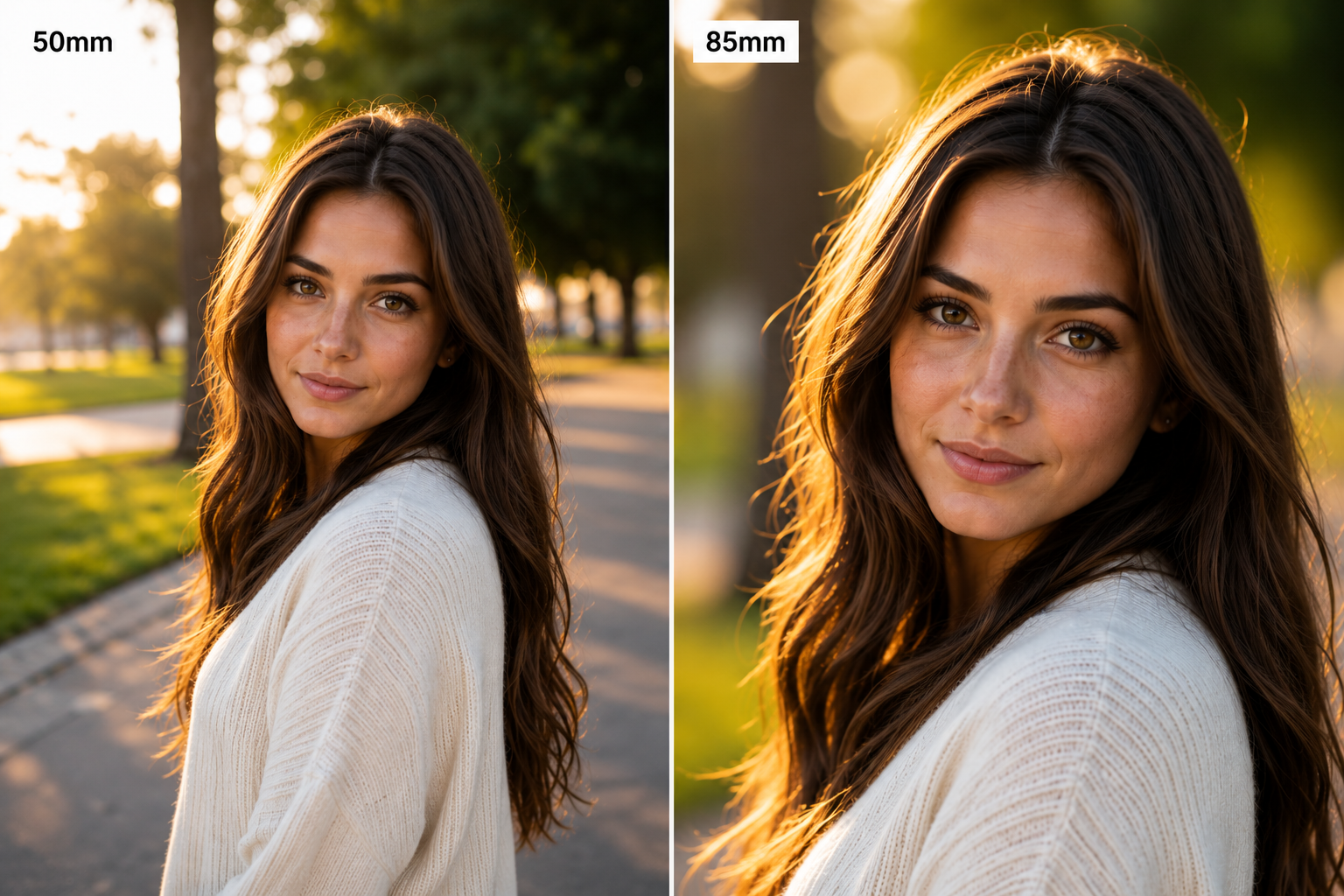
Focal Length and Compression
Compression — how a lens renders the relationship between subject and background — is one of the most significant differences between these two focal lengths. The 85mm compresses perspective more than the 50mm, which means the background appears closer to the subject, features look flatter and more proportional, and the overall image takes on that "classic portrait" quality that photographers often describe as flattering.
The 50mm renders a scene closer to how we see it naturally. There's less compression, which keeps the background feeling appropriately distant while the subject looks proportional. It's not as dramatically "portrait-like" as the 85mm, but it doesn't try to be.
Background Separation
Background blur (bokeh) is driven by three factors: aperture, distance to subject, and distance to background. Focal length affects this indirectly — because the 85mm requires you to be further from your subject to get the same framing, and because it has a longer focal length, it produces more background blur than the 50mm when shooting at identical apertures.
In practice: an 85mm at f/1.8 from 8 feet produces significantly more background separation than a 50mm at f/1.8 from 5 feet, even though both might frame the subject identically. If smooth, creamy backgrounds are a priority in your portrait work, the 85mm delivers this more naturally.
Working Distance
Working distance is where the 50mm holds a clear advantage. For a head-and-shoulders framing, the 50mm typically requires around 4–6 feet. The 85mm needs roughly 8–12 feet for the same shot.
That difference matters constantly. Indoor sessions in normal rooms often don't give you 10 feet of clearance. Street portraits require less distance between you and a stranger. Small studios without extra space default to shorter focal lengths. The 50mm navigates these constraints without compromise.
The extra working distance of the 85mm does have a social benefit worth noting: subjects who feel uncomfortable being photographed tend to relax more when the camera isn't close to their face. If you work with people who aren't at ease in front of a lens, the 85mm's working distance helps.
50mm for Portraits
The 50mm is the more versatile lens. It moves between portrait work and everyday shooting without asking you to adjust your expectations. For portraits, it handles everything from full-body shots to close headshots with minimal distortion and a natural rendering that works in almost every situation.
- Strengths: Short working distance, versatile framing, excellent for indoor shoots, naturally flattering at moderate distances, easy to find a fast, affordable version in any system.
- Limitations: Less background separation than 85mm at equivalent settings, less compression for tight headshots, not as "portrait-specific" in its rendering.
85mm for Portraits
The 85mm is the more specialized tool. Most photographers who own one use it primarily for portraits — and for that specific purpose, it performs exceptionally well. The compression, background blur, and working distance combine to make portrait sessions feel less rushed and more controlled.
- Strengths: Superior background separation, flattering compression for faces, comfortable working distance for subjects, excellent image quality in most implementations.
- Limitations: Needs significant space, harder to use indoors, less versatile for non-portrait work, tends to cost more than comparable 50mm options.
Comparison Table
| Feature | 50mm | 85mm |
|---|---|---|
| Angle of view (full frame) | ~47° | ~29° |
| Compression | Natural/moderate | Stronger |
| Background separation | Good | Excellent |
| Working distance (head/shoulders) | 4–6 ft | 8–12 ft |
| Indoor versatility | High | Moderate |
| Versatility for non-portrait work | High | Lower |
| Typical price (f/1.8) | Lower | Higher |
| Best for | All-around portraits, indoors, everyday | Dedicated portrait sessions, outdoor work |
Ideal Use Cases
The 50mm is the right choice when you need one lens to cover portraits and everything else — travel, street photography, documentary work, events. It doesn't specialize, which is exactly the point.
The 85mm is the right choice when portraiture is your primary focus and you have the physical space to use it. Wedding photographers shooting outdoor formals, portrait photographers with dedicated studio setups, and anyone who wants maximum background separation all benefit from what the 85mm does specifically.
Which to Buy First
If you're choosing between the two as a first dedicated portrait lens: buy the 50mm. It costs less, is easier to use in varied conditions, and teaches you more about portrait photography because it doesn't lean on compression to do the work for you. Once you understand what you want from a portrait lens, you'll know whether adding the 85mm is worth it.
If you already own a 50mm and shoot portraits regularly: the 85mm is a logical and meaningful addition. You'll notice the difference immediately, and you'll likely reach for each in different situations.
Frequently Asked Questions
Is the 85mm better than the 50mm for portraits?
Better depends on your situation. The 85mm produces more compression, better background separation, and is generally more flattering for tight headshots. But it requires more working distance and is harder to use indoors. The 50mm is more versatile for everyday portrait work.
What working distance does the 85mm need for a headshot?
For a head-and-shoulders portrait, an 85mm typically requires roughly 8–10 feet of distance. That's usually enough in most outdoor locations or spacious indoor settings, but can be a problem in tight rooms.
Can I use an 85mm indoors?
Yes, but you need enough room to back up. In a small bedroom or hallway, an 85mm may be impractical for close framing. The 50mm handles indoor portraits more easily in constrained spaces.
Which is better for photographing couples?
The 85mm is excellent for couples — it frames two people naturally at a comfortable working distance and produces strong background blur that separates them from the environment. The 50mm works fine but requires closer positioning.
Do I need both a 50mm and an 85mm?
Not necessarily. If you already own a 50mm and primarily shoot portraits, an 85mm is a meaningful upgrade. But they occupy a similar purpose — if budget is a concern, master one before adding the other.