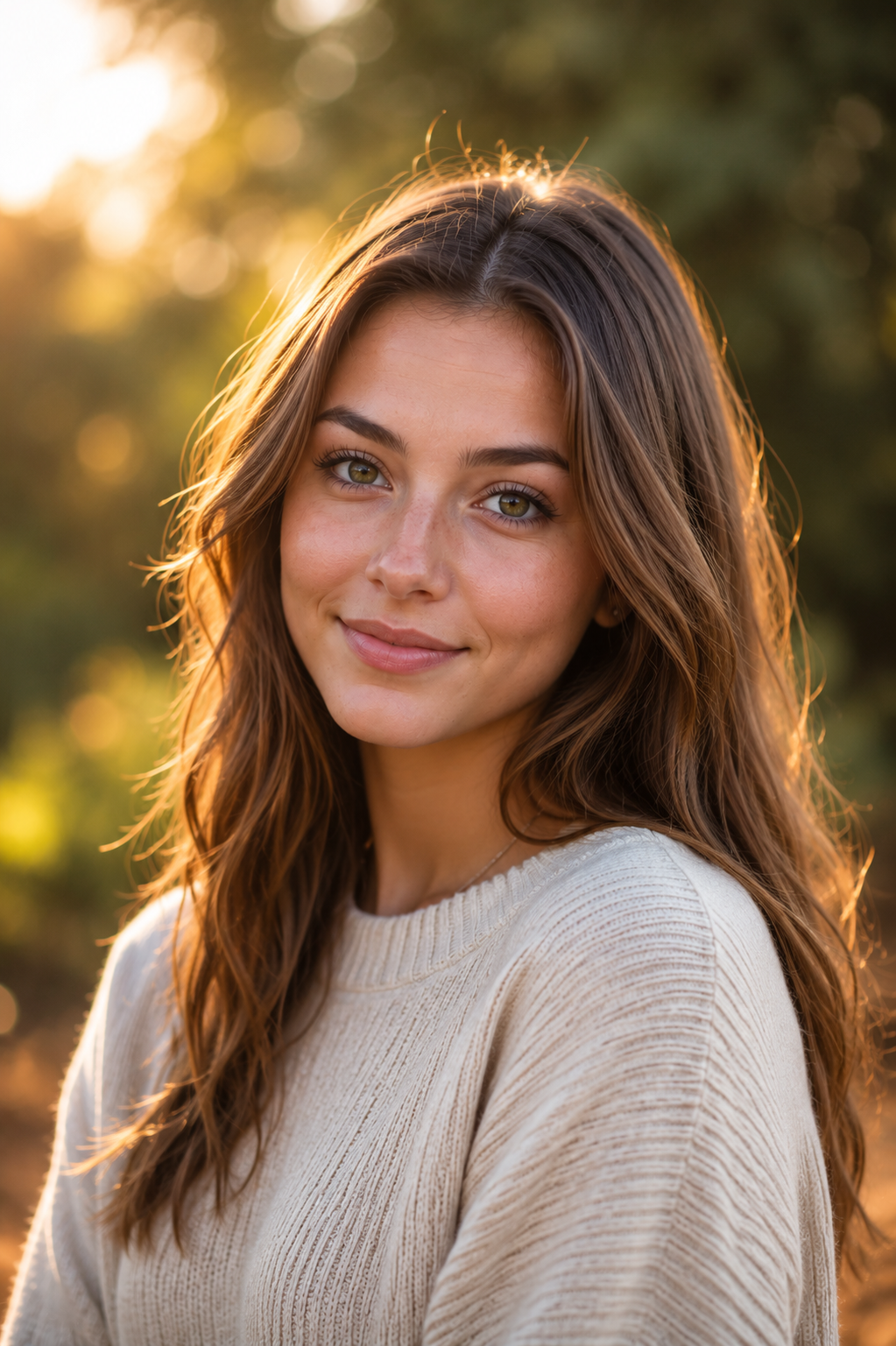
Why the 50mm f/1.8 First
The 50mm f/1.8 is the most commonly recommended first portrait lens — and the recommendation holds up for straightforward reasons. It renders a perspective that most viewers find natural and flattering. It's available in almost every camera system. Fast f/1.8 versions exist at modest cost. And it's versatile enough to use beyond portraits without feeling like a dedicated specialty tool.
For a beginner learning portrait photography, these properties matter more than the marginal gains of a more specialized focal length. You want a lens that gets out of your way while you focus on lighting, posing, and connection with your subject — not a piece of gear requiring careful management.
On a full-frame camera, 50mm produces a natural perspective that closely matches how we see people in conversation. It requires moderate working distance for head-and-shoulders framing, handles indoor sessions without demanding enormous spaces, and produces background blur at f/1.8 that's immediately recognizable as a portrait look.
What a Fast Aperture Actually Changes
A kit zoom lens typically delivers a maximum aperture of f/5.6 at the long end. A 50mm f/1.8 prime opens to f/1.8. That's a difference of about 10x in the amount of light reaching the sensor — which translates to the ability to shoot 3–4 stops faster shutter speeds in the same lighting conditions.
In practice: you can shoot sharp portraits in a dimly lit room that would be unworkable with a kit zoom. You can freeze movement with faster shutter speeds. You can produce soft, blurred backgrounds that separate your subject cleanly from the environment behind them. These are the portrait qualities that are hardest to replicate with post-processing — they require the right tool at the moment of capture.
The 35mm Option for Crop Sensor Shooters
If you're shooting on an APS-C camera (most entry- and mid-level DSLRs and mirrorless cameras), the crop factor changes how each focal length behaves. A 50mm on APS-C gives you a roughly 75–80mm equivalent field of view — which is actually excellent for tight portrait work, but can feel longer than expected for beginners who want something more versatile.
A 35mm prime on APS-C gives you an effective field of view of approximately 52–56mm, which is closer to the natural perspective that makes the 50mm popular on full-frame. If versatility is important to you and you're on a crop body, the 35mm f/1.8 is a strong alternative starting point.
Both are genuinely good choices on APS-C. The 50mm will feel more telephoto (which some find easier for isolating subjects); the 35mm will feel more like a standard lens that can also shoot portraits well.
When the 85mm Makes More Sense
The 85mm is widely considered the premier portrait focal length — stronger background compression, more flattering rendering for tight headshots, and enough working distance to let subjects relax. If portrait photography is your specific focus and you have space to work, the 85mm delivers results that are difficult to match with anything shorter.
The limitations are real, though. The 85mm requires significantly more physical space for the same framing, which makes indoor sessions in normal-sized rooms impractical. It's also more expensive for equivalent aperture performance compared to 50mm options in most systems.
Recommendation: if you're starting out and haven't established a clear portrait style yet, begin with the 50mm. Once you know you want to invest in portrait work specifically and you have environments where the 85mm's working distance is manageable, add it then.
The Zoom Alternative
A zoom lens that covers the portrait range — 24–70mm or 70–200mm, depending on your approach — has genuine appeal for versatility. You can shoot wider environmental shots and tighter detail shots without switching lenses. In fast-moving portrait scenarios (children, candid moments), the ability to adjust framing quickly matters.
The cost of zoom versatility is aperture. Standard zoom lenses in the affordable range don't match f/1.8 performance. If low-light capability and strong background blur are priorities — and they usually are for portrait photographers — a zoom in this category will feel limiting for dedicated portrait work.
Zooms become more compelling at the professional end of the price range, where constant-aperture options are available. For beginners evaluating first portrait lenses, a fast prime offers better value per dollar for portrait-specific performance.
What to Ignore
Ignore online sharpness comparisons and micro-contrast discussions when choosing your first portrait lens. At f/2.8 and beyond, the differences in optical performance between quality lenses in the same focal length category are rarely visible in actual portraits. Technical specifications matter far less than the practical properties — aperture range, working distance, weight, and how the lens handles in real shooting conditions.
Also ignore the impulse to buy the most expensive option available. Better glass doesn't automatically produce better portraits. Lighting, subject relationship, and timing are what actually determine whether a portrait is good.
Building from Here
Start with a 50mm f/1.8 (or 35mm f/1.8 on APS-C). Shoot portraits extensively with it. Learn what the perspective looks like, how background blur behaves at different apertures and distances, and what working distance feels natural with your subjects.
Once you understand what you want from a portrait session, the next steps become obvious. You'll know whether you want more compression and separation (pointing toward an 85mm), wider environmental context (pointing toward a 35mm on full-frame), or more flexibility in framing (pointing toward a zoom). That decision is much easier to make from experience than from a starting position of uncertainty.
Frequently Asked Questions
Is a 50mm f/1.8 good enough for professional portrait work?
Yes. The focal length and aperture are both well within professional range. Many working portrait photographers use 50mm lenses as their primary or secondary portrait lens. The limiting factor is rarely the lens.
Should I buy a 50mm or 85mm as my first portrait lens?
For most beginners, the 50mm is the better starting point. It's less expensive, more versatile, easier to use indoors, and teaches you to work deliberately with composition and light. Once you understand your portrait style, you'll know whether the 85mm is worth adding.
What aperture should I use for portraits as a beginner?
Start around f/2 to f/2.8. Shooting wide open at f/1.8 looks appealing but requires very precise focus, and you can easily lose an eye or ear to shallow depth of field. Stopping down slightly gives you more margin while still producing strong background blur.
Can I shoot portraits with a kit zoom lens?
Yes, but the results will be limited. Kit zooms have narrow maximum apertures, which reduces background blur and makes low-light shooting harder. A dedicated prime lens delivers noticeably better results for portrait-specific work.
Does the 35mm work well for portraits on a crop sensor?
Very well. On an APS-C camera with a 1.5x or 1.6x crop factor, a 35mm gives you an effective field of view close to 50–56mm — which is a natural, flattering portrait perspective. It's an excellent choice for APS-C shooters.