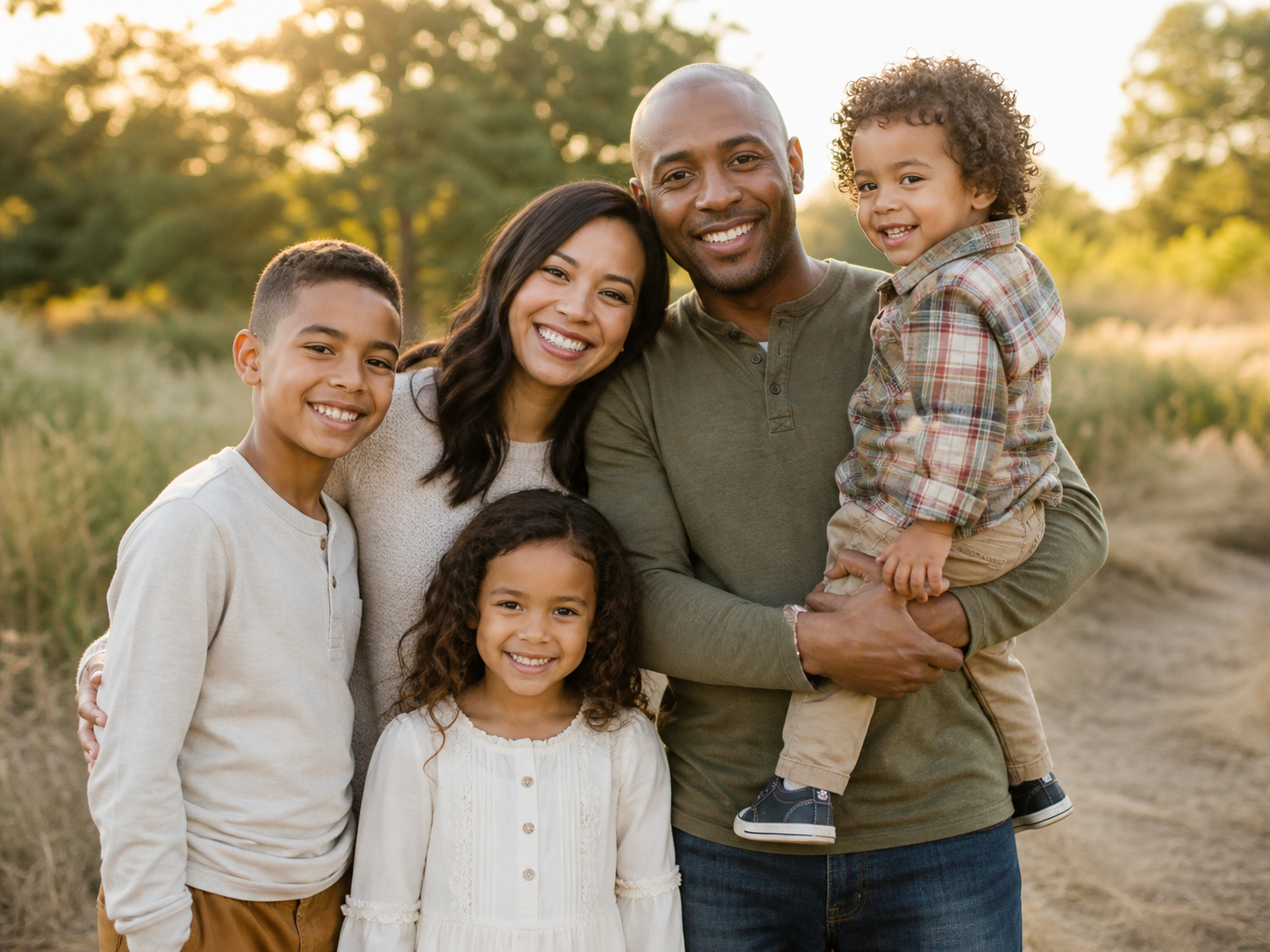
The Challenge of Family Photography
Family photography is demanding in ways that portrait studio work isn't. The subjects move constantly and unpredictably — especially children. Lighting shifts from one room to the next, from indoors to outdoors, from overcast to direct sun. Group compositions go from a full family of six to a single child mid-run, often within seconds.
No single focal length solves all of this perfectly. The question is which tool covers the most situations with the least compromise, given how and where you actually photograph your family.
The 35mm for Families
The 35mm is a strong all-around choice for family photography, particularly on full-frame cameras. It's wide enough to capture group shots and environments — a family in a kitchen, children around a table, a full family on a beach — without backing too far away. It's still narrow enough to isolate subjects when you want to.
The 35mm works well indoors because the working distance for individual portraits is shorter, meaning you can shoot in a typical room without running into walls. It renders a perspective that's slightly wider than "natural," which gives photos a sense of environmental context and place — something particularly valuable for family documentary work.
On an APS-C crop camera, a 35mm behaves more like a moderate normal lens (equivalent to about 52–56mm), which suits portrait-style family shots but has less environmental width. For APS-C shooters who want genuine wide-angle coverage, a 24mm or 28mm prime fills that role instead.
The 50mm for Families
The 50mm is the natural starting point for most photographers, and family photography is no exception. It handles individual portraits and small groups well, performs in lower light at f/1.8, and produces a flattering, natural-feeling perspective that works for both children and adults.
Where the 50mm begins to feel limiting in family contexts is with larger groups — fitting four or five people comfortably requires backing up considerably, which isn't always possible. It's also less useful than a telephoto for outdoor candids where you want to photograph children without them noticing you.
For families with one or two children and a mix of portrait and candid shooting, the 50mm handles the majority of situations well. It's the lowest-friction choice if you're building a lens kit from scratch.
Standard Zoom Coverage
A standard zoom covering 24–70mm or 18–55mm gives you the widest range of flexibility for the chaotic reality of shooting families. You can frame a full group shot at the wide end, switch to a tighter portrait mid-session, and adjust framing for whatever happens next — all without changing lenses or repositioning significantly.
The trade-off is aperture. Consumer-grade zoom lenses in this range often top out at f/3.5 to f/5.6, which limits low-light performance and reduces background blur compared to what a fast prime offers. If you frequently shoot indoors or in shade, the aperture limitation will show. In good outdoor light, a standard zoom covers family photography comfortably.
Higher-end standard zooms with wider maximum apertures reduce this trade-off but come at higher cost and increased weight — worth it for some photographers, excessive for others who shoot families casually.
Telephoto for Candids and Outdoor Sessions
A telephoto zoom — something in the 70–200mm range — is underrated for family photography. The longer focal length compresses perspective, creates strong background separation, and allows you to photograph children playing at distance without them modifying their behavior because they see a camera nearby.
Outdoor family sessions — at parks, beaches, or in the backyard — are where a telephoto really earns its place. You can capture genuine moments of play, interaction, and expression without being physically intrusive. The resulting images often feel more natural than those taken with a wider lens from close range.
The limitations are its size, weight, and the need for more light (or image stabilization) to hand-hold at longer focal lengths. It's rarely a first lens purchase but makes an excellent second lens for photographers who prioritize candid outdoor work.
Indoor vs Outdoor Priorities
If most of your family photography happens indoors — holidays, birthdays, everyday life at home — prioritize a fast prime. The aperture advantage of f/1.8 or f/2 matters enormously in household lighting, and the shorter focal lengths (35mm or 50mm) suit the working distances of typical rooms.
If most of your shooting is outdoors — weekends at the park, beach days, outdoor sports — a zoom lens becomes more competitive, since the aperture limitation matters less in good light and the flexibility to adjust focal length quickly is more valuable. A telephoto zoom becomes especially relevant if your children play sports or spend time at distance from you.
Building a Two-Lens Kit
The practical two-lens family photography kit is a fast 35mm or 50mm prime plus a zoom that covers either the wide-normal range or the telephoto range — depending on whether you shoot mostly indoors or outdoors respectively.
The fast prime handles the indoor, low-light, portrait-style shooting where aperture matters. The zoom handles the flexible outdoor or event work where subject distance varies unpredictably. Together they cover the full range of family photography scenarios without excessive gear weight or cost.
Which zoom you reach for as the second lens depends on what you actually shoot. Most family photographers find the standard zoom (24–70mm equivalent) more useful day-to-day; photographers with active kids who play outdoors often find the telephoto more valuable in practice.
Frequently Asked Questions
What is the best focal length for family portraits indoors?
A 35mm or 50mm prime works well indoors for family groups — wide enough to include multiple people without backing into furniture, fast enough for lower light, and flattering for the people in the frame. If you need to fit a large group, a 24mm or 28mm gives you more room.
Is a zoom or prime better for family photography?
A zoom offers more flexibility for chaotic family scenarios where distances change constantly — think kids running, groups breaking apart, candid moments. A prime performs better in low light and produces more background blur, but requires more physical adjustment. Many family photographers keep both and reach for the zoom when things get unpredictable.
What aperture should I use for family group shots?
Stop down to at least f/4 for group shots where people are at different distances from the camera. At wider apertures like f/1.8 or f/2, people at the edges of a group can fall out of focus. Use a wider aperture for single subjects or tight pairs.
What focal length works best for photographing kids in motion?
A 35mm or a standard zoom around 24–70mm gives you the flexibility to follow moving children without constantly repositioning. A telephoto zoom (70–200mm) is excellent for outdoor play where you can keep distance and let them move freely without the camera in their face.
Can I shoot good family photos with a kit lens?
Yes, especially outdoors in good light where the aperture limitations matter less. Indoors or in lower light, a fast prime will produce noticeably better results. The kit lens is a reasonable starting point; the limitations become apparent when shooting in variable light conditions.